

10 Mar THE 10X GROWTH PLAYBOOK
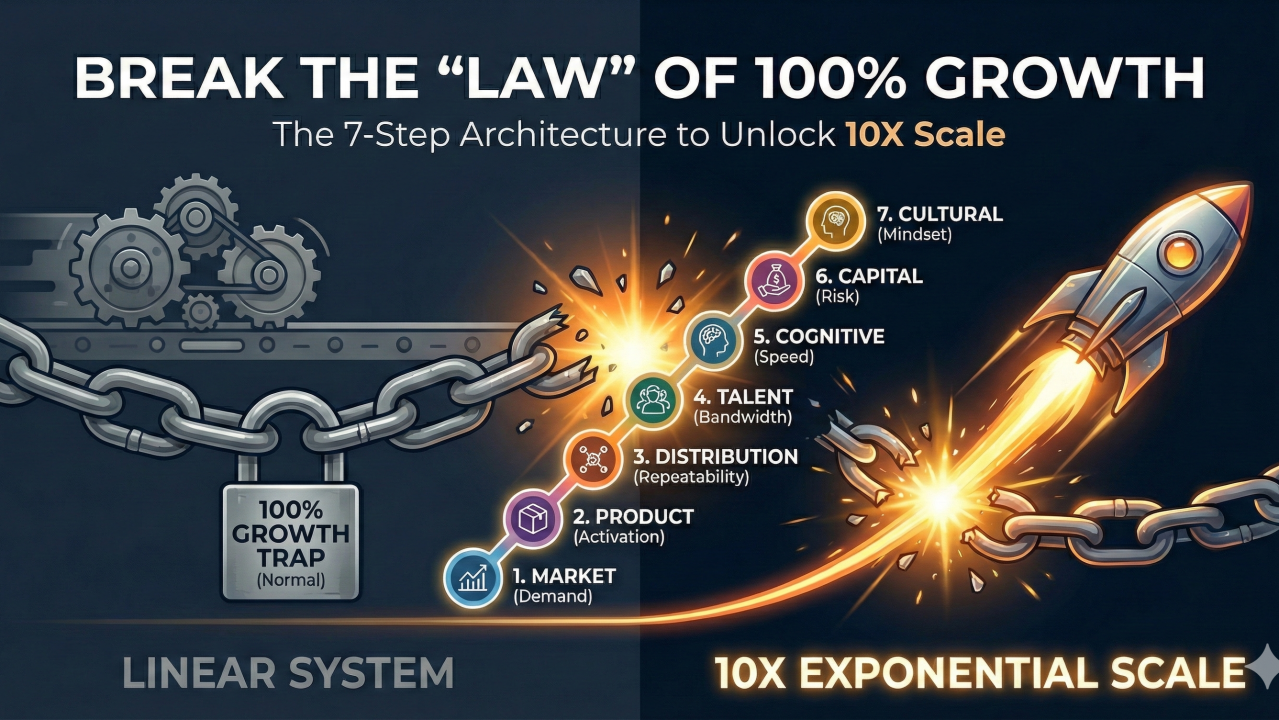
How to Break the “Law” of 100% Growth
Most startups settle around 2x, sometimes 3x annual revenue growth (100-200% YoY).
Not because the market limits them — but because their internal systems are architected and calibrated for it.
To grow 5-10x in a year, you cannot just try harder ❌ You must address the root causes and change/rebuild the machine so it can grow faster. ✅
The Core Rule
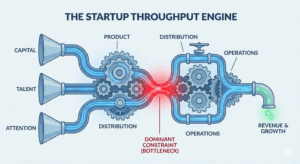
A company is a throughput system.
Throughput is the rate at which a company produces, processes, sells and delivers finished goods and services over a specific period.
Throughput is limited by one dominant constraint at a time.
If everything feels broken, you haven’t identified the real one yet.
Fixing anything other than the dominant constraint is an illusion of progress. It feels productive, but it changes nothing.
This playbook helps you identify the real blockage — and eliminate it, so you can unleash your growth.
This was always relevant and became critical in the age of AI.
Content:
Part I : Diagnostic Part II: Stress Test Part III: Architecting for 10X
PART I: THE DIAGNOSTIC
- Where Is the Blockage?
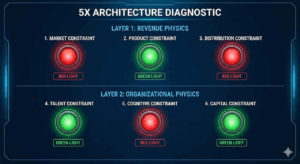
- Do not guess. Use the below Red Light / Green Light checklist.
- 3 Layers : Revenue physics, Organisational physics, Psychology.
- Within each layer, solve in order. If Level 1 (Market) is red, do not work on Level 2 (Product).
LAYER 1 — REVENUE PHYSICS
(Does the engine generate force?)
1. The Market Constraint (Demand)
If the urgency to buy your solution is weak, nothing scales.
The Test
- B2C / PLG: If you turned off paid acquisition for 30 days, would users still sign up?
- B2B / Sales-Led: If you stopped outbound sales for 30 days, would customers chase you?
The Metrics
- Referral + Expansion revenue > 25% of new revenue
- One clear ICP drives > 60% of pipeline
- Inbound/organic growing >10% MoM (for PLG)
🔴 Red Light: You must buy every lead. Messaging constantly shifts. Sales cycles feel educational, not urgent.
🟢 Green Light: The market pulls the product from you.
Tool if Red: The “Hair on Fire” Interview & Drill Down
Interview 10 recent customers.
Ask: “What happened the day before you started looking for a solution like ours?”
You are searching for the Trigger Event behind their decision to search for a solution.
The Drill Down (Don’t accept the first answer):
- Customer: “We wanted better visibility.” (Fluff response)
- You: “Why did you need visibility that specific morning? Why not 3 months ago?”
- Customer: “Well, the board meeting was coming up.”
- You: “And what happened in the previous board meeting that made this urgent?”
- Customer: “I couldn’t answer the CAC question and looked like an idiot.”
THAT is the trigger.
- Bad Heading 1 (as slide title): “Get Better Visibility.”
- Good Heading 1 (as slide title) : “Never Look Stupid in a Board Meeting Again.”
Rewrite your Main Messaging on the homepage to address the Trigger Event, not the “Benefit”.
2. The Visibility Constraint (Volume)
Sometimes the message is perfect, but the room is empty. You have zero to little market awareness. You cannot optimize a funnel that is cold and has no flow.
The Test
- The “Tree in the Forest” Check: How many new, qualified people saw your core offer yesterday?
The Metrics
- Seed Stage: example >500 unique qualified impressions / week.
- Series A: example >5,000 unique qualified impressions / week.
🔴 Red Light: You are tweaking the landing page copy, but you only had 14 visitors today. (You are optimizing noise).
🟢 Green Light: You have enough traffic to statistically prove that your offer is working (or failing).
Tool if Red: The “1,000 Eyeballs” Rule
Founders love to pivot strategy before they have data.
The Rule: You are not allowed to change your Price, Product, or Main message until e.g. 1,000 [set your right number] qualified people have seen the current version.
- Scenario A: You launched a campaign. 1,000 people clicked. 0 bought.
- Diagnosis: You have a Message/Product Problem.
- Action: Give me a call. We have a deeper tool to help you.
- Scenario B: You launched a campaign. 40 people clicked. 0 bought.
- Diagnosis: You have an Obscurity Problem.
- Action: Do not change the slide deck. Do not rewrite the code. Turn up the marketing volume. Pick one marketing channel (Cold Email, LinkedIn, Ads) and hit the 1,000 mark. Give me a call. We have a deeper tool to help you.
=> Don’t confuse silence with rejection.
3. The Product Constraint (Activation Friction)
Growth cannot exceed activation throughput.
The Test
- PLG / B2C: Can a stranger reach real value without human intervention?
- B2B / Enterprise: Can the buyer clearly see ROI within 7 days of signing?
The Metric
- Time to First Value (TTFV) OR Perceived Time to ROI
🔴 Red Light: Requires “Setup Call”, heavy services dependency, or manual integrations. No visible progress during onboarding.
🟢 Green Light: Users activate while you sleep.
Tool if Red: The “Empty Chair” Audit (a) & Pizza Tracker (b).
A. Record a new user trying to reach value. Count clicks. Watch for confusion. If human intervention is unavoidable (enterprise), apply The “Pizza Tracker” Method. Anxiety kills activation. Clarity restores momentum.
B. The Pizza Tracker method:
Domino’s Pizza solved this problem brilliantly. Making a pizza takes 20 minutes. In the old days, you ordered and then sat in the dark, wondering if they forgot you. Then they invented the Pizza Tracker. It doesn’t make the pizza cook faster. It just shows you exactly where the pizza is:
-
-
- Order Placed (We heard you).
- Prep (We are working on it).
- Bake (It is in the oven).
- Quality Check (Almost there).
- Out for Delivery (Get ready).
-
Because you can see the progress, your anxiety disappears. You don’t call the store to check on the order. You feel in control, even though you are doing nothing.
How to Apply This to Software (The “Fake” Progress Bar)
If your software has a “black box” moment—where the user has to wait for a human to do something or a script to run—you must build a Pizza Tracker interface.
Instead of a blank screen or a generic “Welcome, we will email you later” message (which is bad for onboarding), you show a live, pulsating status dashboard.
The 3 Components of a Software Pizza Tracker:
1. Visual Evidence of Work: Even if the process is manual (e.g., your Customer Success Manager, “Steve,” is manually uploading their CSV file), the user’s screen should say:
Step 1: Account Created ✅
Step 2: Data Validation in Progress… (Processing)
Step 3: Dashboard Configuration (Pending)
2. The “Why” (Education): Don’t just say “Waiting.” Explain why this step adds value.
Instead of: “Loading…” Say: “Analyzing your data to find the top 3 revenue opportunities…” (Now the wait feels productive, not annoying). A Clear ETA: Uncertainty is worse than a long wait. “Estimated completion: 2:15 PM.”
Conclusion: Engineer visibility into the dashboard:
4. The Distribution Constraint (Repeatability)
If acquisition is not repeatable, growth plateaus.
The Test
- Do you have one dominant channel?
The Metrics
- Best channel drives >40% of new revenue
- CAC variance <20% as spend increases
- Payback period stable over 3 months
🔴 Red Light: Each quarter depends on a new tactic. “Hero campaigns” save the number. CAC spikes when scaling spend.
🟢 Green Light: You put €1 in, you get predictable output.
Tool if Red: The Channel Starvation Diet
Kill the bottom 3 channels. Take your best channel. Allocate 80% of resources to it for 90 days.
Optimize: Creative, Landing page, Sales follow-up.
You do not need 5 channels to reach $10M ARR. You need one that works.
LAYER 2 — ORGANIZATIONAL PHYSICS
(Can the structure absorb force?)
5. The Talent Constraint (Execution Bandwidth)
Growth increases entropy (chaos).
The Test
- If you left for 30 days, would hiring quality improve, decline, or stay flat?
The Metrics
- 80% of hires pass 90-day review
- Managers close >70% of hiring loops without founder involvement
🔴 Red Light: Founder interviews every candidate. Middle management is weak. Hiring slow because “culture fit” unclear.
🟢 Green Light: The team hires better than the founder would.
Tool if Red: The “Bar Raiser” Veto
The Trap: Hiring managers are desperate to fill seats to hit their goals. Subconsciously, they lower standards just to get a body in the chair. You (the Founder) act as the “Quality Police,” interviewing everyone to stop this. You become the bottleneck.
The Fix: You must institutionalize the “Police” role so you can step out.
The Protocol:
- Select Your “Bar Raisers”: Identify the top 10% of your staff who embody your standards perfectly.
- The Rule: Every interview loop must include one Bar Raiser from a different department (e.g., A Lead Engineer interviews a Sales candidate).
- The Power: The Bar Raiser focuses on one question: “Is this person better than the average of our current team?”
- The Veto: The Bar Raiser has absolute Veto Power. Even if the Hiring Manager loves the candidate, if the Bar Raiser says “No,” the hire is dead.
The Result: You stop interviewing candidates. You only interview and train the Bar Raisers. The system now protects its own quality.
6. The Cognitive Constraint (Decision Speed)
Throughput stalls when decisions queue at the top.
The Test
- How many non-strategic decisions require CEO approval?
The Metric
- Decision latency <24h for non-strategic issues
🔴 Red Light: Budget approvals sit in inbox. Edits require CEO. Offers cannot be sent without sign-off.
🟢 Green Light: The CEO learns about successful initiatives after they launch.
Tool if Red: The “Checkbook Authority” Matrix
Publish clear spending authority : [example]
- Junior: €100
- Manager: €1.000
- VP: €10.000
If someone asks for permission within their level — point to the matrix. Do not answer.
Add The “Disagree & Commit” Rule: Once a decision is made at the correct level, it cannot be reopened unless data changes. Velocity requires finality.
7. The Capital Constraint (Risk Tolerance)
Are you optimizing for survival or dominance?
The Test
- Are you aggressively scaling the channel that works?
The Metric
- Burn multiple aligned with growth stage. Runway >12 months while scaling winning channel.
🔴 Red Light: “We should slow down to extend runway by 2 months.” (Efficiency mode caps growth at 100%).
🟢 Green Light: “This channel works. We will scale it aggressively while runway stays safe.” (Opportunity mode allows 5x).
If growth is clearly, demonstrably, profitable at EBITDA or FCF level, growth organically adds runway.
Tool if Red: The “Unlimited Budget” Protocol
The Trap: Your best channel is working, but you cap it arbitrarily. Example: “Our Facebook Ad budget is €20k/month.” Why? “Because that’s what we budgeted.”
This is 2x thinking. If you put €1 in a machine and get €4 back, why would you stop putting dollars in? You are effectively saying, “I only want to make 4x profit on €20k, not €100k.”
The Fix: Remove the “Budget Cap” on your primary channel. Replace it with an “Efficiency Guardrail.”
The Protocol:
- Define the Guardrail: “We will spend unlimited dollars on [Channel X] as long as:”
- CAC stays below [set your number e.g. €500].
- Payback period stays under [set your number e.g. 4 months].
- The Weekly Review: You do not ask “Did we stay under budget?” You ask “Did the unit economics hold?”
- The Result: You stop managing cost. You start managing yield. You will likely spend 3x more than you planned, but you will grow 3x faster with the same safety profile.
LAYER 3 — THE PSYCHOLOGICAL CONSTRAINT
(are you ready to face the truth?)
Before fixing any structural issue, ask:
What decision are we avoiding because it makes us uncomfortable?
Raising prices? Firing an early employee? Killing a product line? Delegating authority?
Often the real constraint is emotional, not operational.
Final Thought
If you feel exhausted, it usually means you are compensating for a broken architecture with human effort.
Effort does not scale. Systems scale.
Find the dominant constraint. Fix it. Then repeat.
PART II — THE STRESS TEST
The “Break the System” Workshop
Run this quarterly with leadership.
Setup: “Tomorrow, our revenue triples instantly. We cannot hire for 60 days.”
Rule: No one is allowed to answer “We need more people.”
Question: “What breaks in 48 hours?”
The Question: “In your specific department, what breaks in the first 48 hours?”
The likely answers (The Truth):
- Customer Success: “We can’t onboard them. We do it manually.” => Constraint: Product/Activation.
- Sales: “I can’t process the contracts fast enough.” => Constraint: Legal/Ops.
- Engineering: “The database locks up at that volume.” => Constraint: Tech Debt.
The first real structural failure is your dominant constraint. Fix that. Ignore everything else.
PART III — ARCHITECTING FOR 10X
Stop planning forward. Plan backward.
The 5x Worksheet (Example – use 10x or whatever #):
- Current Revenue: €2M
- 5x Target: €10M
- ACV: €20k
- Customers Needed: 400
Now test the architecture:
- Rep closes 20/year → need 20 reps (have 4 → Hiring constraint)
- 10% conversion → need 4,000 leads
- Lead cost €500 → €2M marketing budget (Capital constraint)
Most founders discover: Their current plan is mathematically impossible.
Tool: The Variable Swap
If the math creates a budget or headcount you don’t have, you must change the physics.
Do not try to change all variables. Pick ONE to obsess over:
Option A: The Price Lever
- The Move: Double ACV ($20k → $40k).
- The Result: You now only need 200 customers (halving lead volume and sales headcount needed).
- The Cost: You must move upmarket or bundle products.
Option B: The Conversion Lever (see more below)
- The Move: Double Win Rate (10% → 20%).
- The Result: You need half the leads ($1M budget instead of $2M).
- The Cost: You must disqualify 50% of your pipeline earlier to focus only on perfect fits.
Option C: The Expansion Lever
- The Move: NRR becomes 150%.
- The Result: You only need €6M in new business, not €8M.
- The Cost: You must stop hunting and start farming.

Focus on conversion:
To double conversion, you must change the physics of the offer.
Here is the architectural approach to doubling conversion. It relies on the MECLABS Conversion Heuristic:
C = 4m + 3v + 2(i-f) – 2a
Where:
- C = Probability of Conversion
- m = Motivation of user (The “Hair on Fire” problem)
- v = Clarity of Value Proposition (The Main Messaging)
- i = Incentive (The “Hook”)
- f = Friction (The “Work”)
- a = Anxiety (The “Risk”)
To double conversion, you must pull the heaviest levers: Friction and Anxiety.
1. The Transactional Friction Lever (The “Lazy” Fix)

Rule: Every field you ask a user to fill out online cuts conversion by ~20-50%.
The Audit: look at your signup form.
- Do you ask for “Company Name”? (Why? You can enrich that later).
- Do you ask for “Phone Number”? (Unless you are calling them in 5 minutes, delete it).
- Do you require a credit card for a trial? (This kills conversion by ~80% but increases lead quality. If you need volume, remove it).
The Architectural Fix: “Progressive Profiling”
Don’t ask for marriage on the first date.
- Step 1: Ask for Email only. (Capture the lead).
- Step 2: After they click “Get Started,” ask for their name and password.
- Step 3: After they see the dashboard, ask for their Company Size.
Result: You capture 100% of the emails, even if they drop off at Step 2. You can now nurture them.
2. The Political Friction Lever (The “Courageous” Fix)
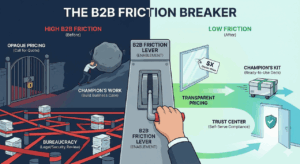
Rule: Friction in Enterprise isn’t just “clicks.” It is Cognitive Load and Political Risk.
Every time you say “Contact Sales for Pricing” or “Email us for Security Docs,” you are forcing your Champion to do work. You are making them build the business case.
The Audit:
- Pricing Friction: Do they have to talk to a human just to know if they can afford you? (result: they ghost you).
- Political Friction: Does your Champion have to create their own slide deck to pitch you to their CFO? (result: they delay the meeting).
- Legal Friction: Do you start with a 20-page NDA? (result: 3 weeks of legal review).
The Architectural Fix: “Buyer Enablement” Stop selling to the buyer. Start selling for the buyer.
- Move 1: Transparent “Starter” Pricing. Even if you are Enterprise, publish a “Starting at €X” price. This lets the Champion budget immediately without a call.
- Move 2: The “Champion’s Kit”. Send them a pre-made “Pitch Deck for your CFO” and a pre-written “Email to your Boss.” Do their homework for them.
- Move 3: The “Trust Center”. Do not make them email you for SOC2 compliance. Put it in a public-facing Trust Center.
Result: You remove the Internal Friction that kills deals when you aren’t in the room.
3. The Anxiety Lever (The “Risk” Fix)
Rule: In B2B, no one gets fired for buying IBM. They get fired for buying you—a risky startup.
The Audit: look at your “Book a Demo” or “Buy Now” section. What happens if it doesn’t work? The user’s brain screams: “Will this waste my time? Will I look stupid?”
The Architectural Fix: “The Risk Reversal”
You must take the risk off their shoulders and put it on yours.
- Weak: “30-Day Money Back Guarantee.” (Standard).
- Strong: “We will implement this for you. If you don’t see ROI in 30 days, we will refund you AND pay you €500 for wasting your time.”
Result: The “Anxiety” variable in the equation drops to zero. Conversion doubles because the downside is gone.
4. The Relevance Lever (The “Who” Fix)
Rule: You cannot convert a user who doesn’t have the problem.
The Audit: check your traffic source. If you are targeting “Small Business Owners” generally, your conversion will be 0.5%. If you target “Dentists struggling with appointment cancellations,” your conversion will be 10%.
The Architectural Fix: “The Specific Landing Page”
Stop sending everyone to your Homepage.
- If they come from a Google Ad for “CRM for Real Estate,” they must land on a page that says “The #1 CRM for Real Estate Agents.”
- If they land on a generic “CRM for Small Business” page, you lose 50% of them instantly.
Result: You match the Motivation (m) perfectly.
Summary: The “Double Conversion” Checklist
- Slash Friction: Remove 50% of your form fields. Use “Login with Google.”
- Kill Anxiety: Add a “Risk Reversal” guarantee that hurts you if you fail, not them.
- Hyper-Relevance: Ensure the Main Messaging matches the Ad copy exactly.
If you do these three things, you don’t need A/B testing software. The lift will be visible to the naked eye.
=> Pick one of the 3 options (Price, Conversion Expansion Lever). That is your Strategy for the year.
You Want To Grow Faster?Let’s Find the Constraint.
DM me “GROWTH” if you want to see where your system breaks. |