
10 Mar No, the SaaS era isn’t ending…BUT…!
If you’re building (or are invested in) SaaS today, read this before you panic.
The market is right about the AI threat to traditional SaaS. But it’s wrong to say SaaS is dead.
Last week, a single AI product announcement (Anthropic Co-Work) erased $1.8 trilion in software market cap over 4 days (Jan 29 to Feb 5).
- Not a new model.
- Not a leap in benchmarks.
- A shift in how work gets executed.
Markets panicked. And the conclusion came fast:
“SaaS is dead.” That’s the wrong diagnosis.
What’s actually breaking is not SaaS. It’s the old SaaS equilibrium.
For 15 years, the formula barely changed.
- Wrap a workflow in a UI.
- Integrate with adjacent tools.
- Charge per seat.
- Grow when your customer hires more people.
- Worry about profitability later
This worked because humans did the work. Software just helped.
AI changes that. When execution moves from humans to agents, seats stop scaling.
And when seats stop scaling, the entire revenue logic cracks. That’s the shock markets are reacting to.
But here’s the mistake.
The market is pricing all SaaS as if:
- they’re just UIs
- sitting in the middle
- with no economic discipline
That’s not true. What’s dying is not software. It’s software that lives only in the thin middle, that’s getting squeezed.
On top, you now have AI agents that execute work directly.
Below, you still have systems of record /context that store truth.
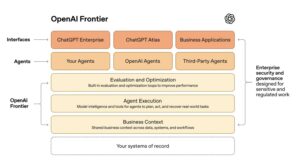
If an agent can act inside your CRM, your ERP, your data warehouse, why does it need your dashboard? => The interface used to be the product. Now it’s just a shell!
That’s why valuations just melted down. Not because demand disappears. But because moats do.
This is where “systems of record” are not enough anymore
Yes, systems of record matter more than ever. Agents need authoritative data. But the real foundation going forward is broader. It’s systems of context.
Not just what the data is. But why it matters. What’s allowed. What’s risky. What’s normal. What’s exceptional.
Context is what lets agents act safely, correctly, and repeatedly.
Without context, automation scales mistakes. With context, it scales judgment.
This is where long-term value accumulates.
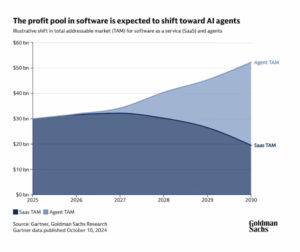
So no — spending on software is not going down. TAM is actually exploding.
It’s growing up in a major way to the point I predict that as AI SaaS is coming for the service industry ($17T), it will have 10-100x the size of cloud which currently stands at $1 Trillion. AI doesn’t reduce software spend. It reallocates and expands it:
Away from:
- per-seat pricing
- cosmetic UIs
- shallow workflow wrappers
Toward:
- execution layers
- systems of record and context
- governance, security, auditability
- outcome-based software
- and yes, services that make all this work in real companies
It’s a transfer of budget.
Now the part founders really need to hear.
AI-native SaaS does not get the luxury of sloppy economics that most listed SaaS have showed. Their fat gross margins (70-90%) should have turned into massive operating free cash flow margins by now except that in almost all cases, they didn’t (the industry averages 5-10%).
In fact, AI-enabled SaaS is currently much more financially challenging than conventional SaaS since each prompt costs 10-100x more than non-AI SaaS API calls. Even if this is bound to decrease substantially as cost per token plummets, agentic workflows will always structurally be more energy hungry than traditional cloud.
Costs have to be understood early. Free cash flow stops being optional.
Many listed SaaS companies are being punished today not because AI kills them, but because they were never built for economic honesty.
AI SaaS will be, has to be.
So, founders: the real dividing line is simple.
Are you building:
- software that assists humans
- or software that executes work?
If you live only in the thin middle,
- charging per seat,
- on someone else’s data,
- with no proprietary context,
you have a problem. Not because your product is bad. But because your position is.
Conclusion: the irony is obvious. SaaS is alive and software is gonna eat the world.
The tools supposedly “killing SaaS” are themselves SaaS.
- Cloud-delivered.
- Subscription-based.
- Sold to enterprises.
SaaS didn’t die. Complacent SaaS did.
And honestly?
That’s probably the best thing that could have happened to builders who care about creating something real.