
10 Mar Who Survives the SaaS Repricing? Gravity, Grunt Work, and the “Zombie” Cut
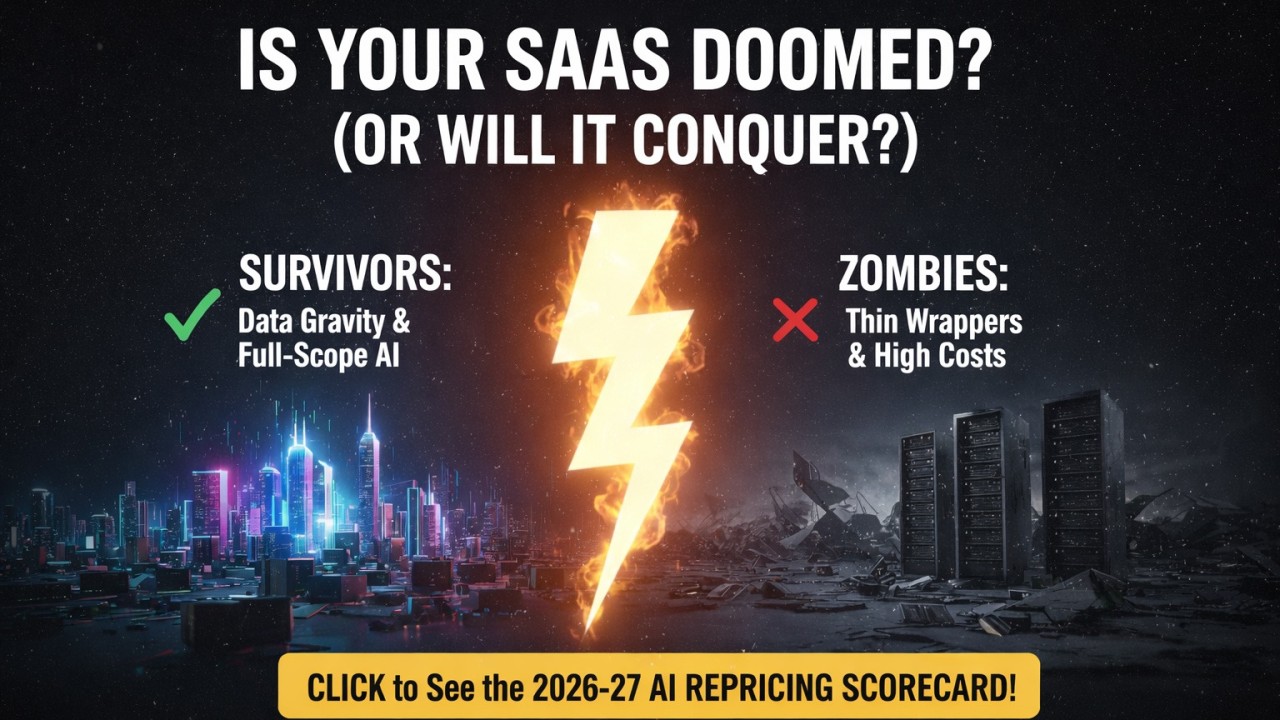
Two weeks ago, I wrote about the “SaaSpocalypse”—the $1.8 trillion market-cap wipeout triggered by the realization that AI agents are no longer just “helpers,” but potential replacements for the software itself. The crash isn’t a “SaaSpocalypse”, it’s the start of a great filter. As AI agents move from novelty to utility, the industry is splitting into two camps: Survivors and the Walking Dead.
Survival isn’t about having the best “AI features.” It comes down to two unsexy factors: Data Gravity and The Hassle Gap.
1. The Survival Logic: Gravity vs. Complexity
The narrative that “enterprises will just build their own apps now” is mostly a myth. While a large Entreprise might develop a custom core mission-critical engine, the vast majority of the economy (SMEs) won’t. Why? The Hassle Gap. Even if AI makes coding “free,” it doesn’t make maintenance, security, or integration free.
The “Data Gravity” Moat
Companies will stay with a platform not because they love the UI, but because their data is already there and moving it is a nightmare (the famous ‘switching costs’.
- The Survivor: Platforms that act as the “System of Record” with 10+ years of historical context.
- The Zombie: “Shallow wrappers” or narrow tools that provide a thin slice of value. If an LLM can replicate your entire feature set in a single prompt, more than EVER you are a feature, not a company.
2. The Winners: Platforms vs. Wedges
For all startups/newcomers, there is a paradox in Go-To-Market (GTM) strategy right now.
- The Startup Strategy: You still need a wedge. Trying to sell a “Full Business Operating System” on Day 1 is most probably a death sentence.
- The End State: To survive long-term, you must expand into a Full Scope Platform.
The Rule of Thumb: Service applications that cover 80% of a company’s needs for a very low cost are un-killable. Small businesses value “one bill and one login” over “best-in-class” fragmentation. Narrow tools that don’t evolve into platforms will eventually be absorbed by the LLM’s native capabilities.
3. The New Kingmakers: Brand Power & LLM Recommendations
In a world where humans don’t “search” for software but agents “procure” it, your moat is Brand Equity.
- Agentic SEO: Will an AI agent recommend your tool to a CFO? It will only do so if you are known to have the best Value-for-Money ratio and a verified reputation.
- Economic Honesty: The “Zombie Era” is defined by companies with 80% margins that should actually be 50%. Survivors are repricing now to bake in inference costs while staying cheaper than a human-led alternative.
4. The Survivor Scorecard
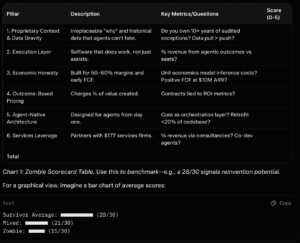
Use this scorecard to determine if a company is a long-term compounder or a “Zombie” trading on past glory. Score each pillar from 0–5 (25+ = Strong Survivor).
(Survivors cluster high on context and execution; zombies lag on economics and architecture.)
5. Open Questions: Help Us Map the Uncharted
The transition from SaaS to “Agentic Services” is happening in real-time. I’d love to hear your thoughts and contributions on these two pivotal questions:
Q1: Can Agent Swarms Replicate Legacy Systems?
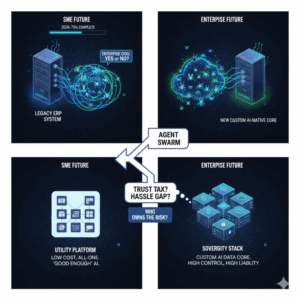
Will we soon see “Migration Swarms”—groups of specialized agents with full system rights—that can dive into a legacy IT stack, audit the logic, map the historical data, and autonomously replicate the entire application into a new, internally developed system?
- The 24-Month Outlook: Is this a fantasy, or will “vibe coding” reach a level where we can “Control-C” a legacy ERP and “Control-V” a custom internal clone?
- The Decision Gap: Even if it’s possible, will Enterprise CIOs take the risk of “owning the code” again, or will the liability of maintaining an AI-generated custom system keep them tethered to SaaS?
Q2: Will SMEs and Enterprises Diverge Completely?
We often talk about “The Market” as one entity, but will we see a radical split?
- Enterprise: Might move toward custom, agent-built internal cores (core and mission critical systems) to maximize “Data Sovereignty.”
- SMEs: Might move toward ultra-low-cost, “good enough” platforms (like a hyper-integrated Zoho or Odoo on steroids) because they lack the bandwidth to manage even an “AI-built” custom stack.
What other questions did I miss? Let me know.
Join the Conversation: Do you believe agent swarms will kill the “Switching Cost” moat by 2027? And if you’re a CIO or Founder, would you trust an autonomous migration? Comment below or DM me—I’ll be synthesizing the best insights for the next update.